
Anybody who’s ever done a tour of duty in thought leadership communications knows there’s a sharp difference between the easy way and the right way.
Easy looks like:
- See what competitors are talking about
- Copy them but put your own product or service spin on it
- Farm out content creation, often to a writer with little experience in the industry
- Attach a name to it, push it out on LinkedIn and the company resource center, and pitch it as an op-ed
Right looks like:
- Research industry conversations, audiences, media coverage, conference agendas, and anything else relevant
- Sort through customer/prospect questions from sales and customer service conversations, and look for patterns
- Interview internal experts and thought leaders
- Determine in advance what thought leadership means to your organization (preferably, a must-have function that meets a definition like “The expression of unique, evidence-based points of view that challenge or engage the target audience’s thinking”)
- Work through the above to come up with the intersection of industry topics, target audience interests and challenges, and internal points of view
- Define these elements in thought leadership strategy documents and editorial calendars
- Develop, distribute, and repurpose your content and engage in follow-up conversations
Marketing and communications pros who handle thought leadership would rather do it right – but often have only enough time and resources to do it easy. Which means resorting to what you’re already talking about in brand and product marketing and simply taking those messages a notch higher.
But is there another way? Is it even possible to truly lead an industry’s thinking and keep it simple and efficient along the way?
Yes and yes.
To be fair, there’s no easy button. There are, however, enough methods, tools, and processes to take thought leadership from pushing the boulder uphill to keeping it on a steady, level path.
Get on the platform
One tool that’s not used nearly enough is the thought leadership messaging platform. Brand and product message maps are common, but generally aren’t well-suited for meeting a thought leadership standard for insightful, thought-provoking, non-promotional content.
To reduce message inconsistency, the thought leadership platform needs to live in harmony with brand and product messaging. But they’re not the same. Thought leadership messaging is an extension of the brand narrative, tailored for a specific purpose: To establish authority for the brand and its thought leaders.
A messaging platform gives you a starting point. It reduces the amount of time spent coming up with new topics every time a thought leader or subject matter expert wants to express a point of view. It also forces a succinct, memorable, repeatable way to talk about important topics in ways that cut across communications channels.
And the messaging platform complements the other tools that make thought leadership marketing and communications more likely to drive business results. (For a deeper dive, I’ve recently written about thought leadership frameworks, custom GPTs for thought leaders, and content marketing processes.)
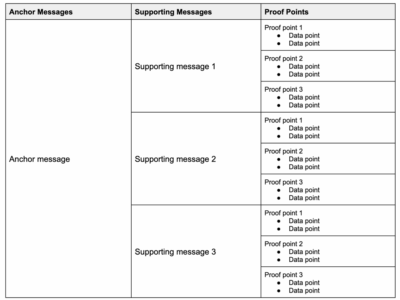
Here’s an example of a thought leadership platform (one that I used with a client earlier this year), before populating with detailed messaging:

To fill in the blanks, start by developing the highest-level messaging, or anchor messages, based on the intersection of topics, audience, and thought leader or internal viewpoints. If I were good at coining terms and getting credit for them (which I’m not), I’d call it something like “topic-audience-thought leader fit.”
Next, get specific. What are three or four messages you want your brand or thought leader to be known for? How can you express a unique or evidence-backed point of view that stands out?
Finally, articulate the proof points, data or research, case studies, examples, and anecdotes that help the message stick.
How often should you revise? Given the simplicity of the document, it’s not hard to tweak the messaging, add proof points, or even develop a new one anytime industry conversations go in a new direction or you find that your existing messages aren’t landing.
Condensing the message
A thought leadership messaging platform can run two to four pages (or dozens of lines in a spreadsheet), even more if you have an abundance of evidence and proof points. So you’ll need a more concise document for prep work for speaking engagements, media interviews, and podcast appearances for the thought leader or SME.
Enter my old friend, the “message triangle.” In a previous role I worked with a well-known public speaking and media coach who had perfected the message triangle as a one- or two-page highlight of a more detailed messaging platform.
The message triangle is a visual that consists of a central, core message in the middle, flanked by three supporting messages forming a triangle. Each message is a one-liner. What we worked from at my previous job was a triangle with “Making healthcare better” in the center, and three supporting statements. The second page repeated the triangle and added some detail, plus a few “deflector” statements at the bottom to address tough or controversial questions and pivot back to the core message.
The message triangle gives any executive a quick way to reference and remember the important messages to convey in just about any setting.
High-stakes, high-value communications
Like all comms and marketing functions, thought leadership needs to be done well to contribute to business results, yet must be executed with a minimum of friction, cost, and inefficiency.
The stakes are high when founders, CEOs, executive teams, and SMEs share their insights publicly. Putting basic methods such as messaging platforms in place, and prompting others on the team to use them, fills that middle ground between easy and hard without compromising quality.
 Beat the rush and build a custom GPT – now – for executive communications