What it’s like to work with ThoughtStarters

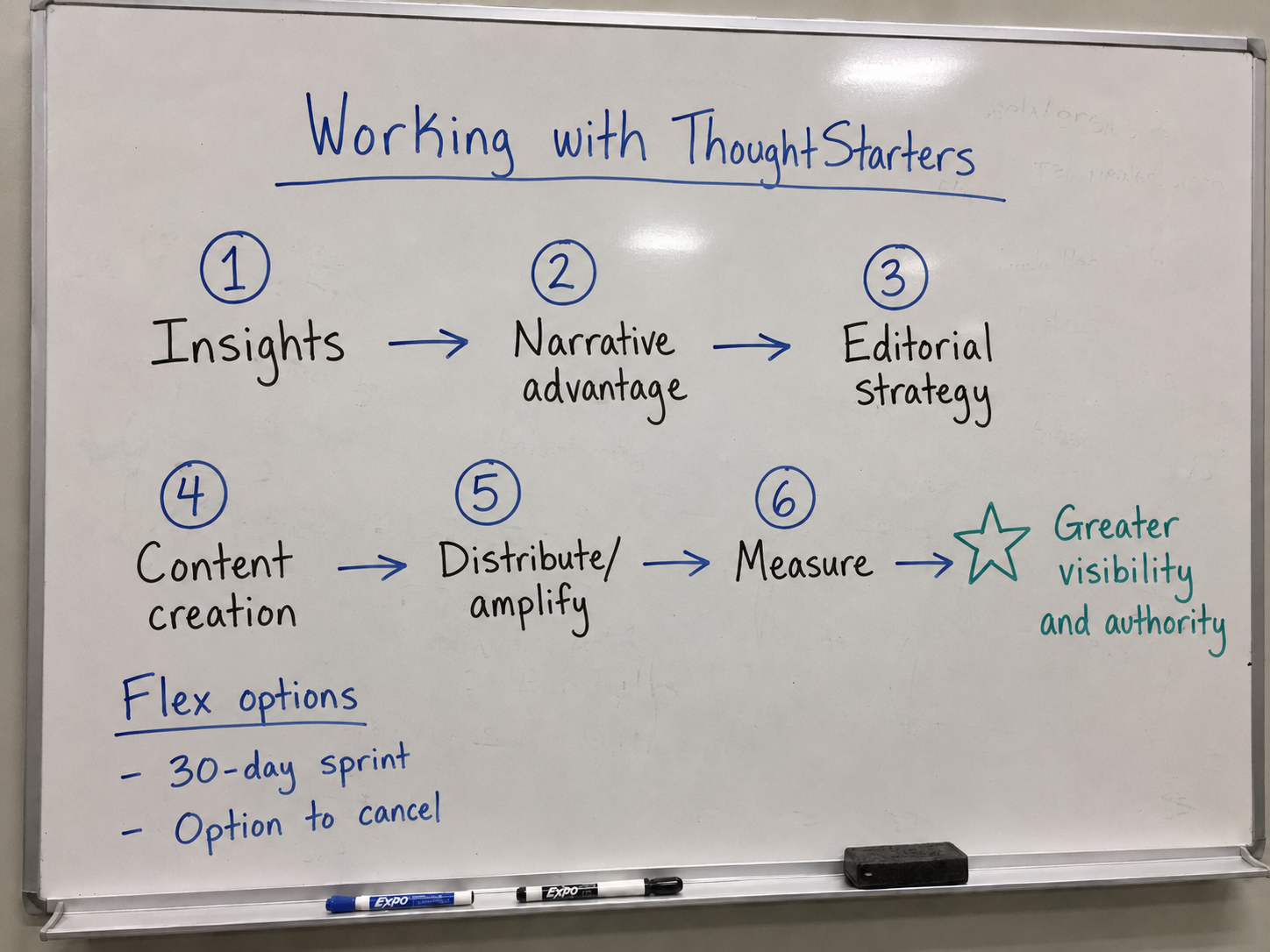
I follow a standardized process to help clients establish a stronger presence in their slice of healthcare.
To be clear, standardized doesn’t mean formulaic, rigid, or productized. It means that over time, these steps have been shown to work in helping startups become more recognized and trusted for their thought leadership.
It’s like a hiking trail that gives you some side-path options. The process is standardized, but the context is custom to your situation.
The following details show how we’d work together.
Week 1: Gather insights
No thought leadership program can survive without leading thoughts. At the outset, we’ll set goals and milestones for achieving thought leadership for the founder/CEO and the brand, defining what success looks like. Then we’ll conduct one to two insight sessions to draw out and refine the founder/CEO’s points of view on topics that matter to the company.
To prepare, and once we’re under an agreement with NDA, I’ll ask for background such as a sales presentation, investor pitch deck, audience personas or ICP, and similar. And I’ll send an insight session agenda and questions in advance.
Week 2: Develop the narrative advantage
Armed with those insights and the relevant background and context, I’ll produce a document detailing your narrative advantage. This becomes the guiding language we use to talk about industry challenges, advocate for your preferred approach, frame new ways of thinking, and show that your team is the right one to solve the right challenges in healthcare. It’s where we answer the question, “What do you want to be known for?”
I build the narrative from two directions: What we want to say, infused by the founder/CEO’s expertise and the company’s founding story, and what the industry is talking about – the hot topics that healthcare purchasers, influencers, regulators, and media are actively discussing.
Week 3: Set the editorial strategy
Establishing the narrative first helps us decide where we want the founder/CEO’s messages to appear and who they’re going to influence. I’ll propose an editorial strategy complete with an approach to LinkedIn posting and commenting, newsletters, contributed articles, speaking engagements, media outreach, video and images, and other possibilities for establishing thought leadership.
I call it an editorial strategy, as opposed to a content strategy, because we always need to think in terms of narrative and news value. The market is conditioned to ignore or reject so-called thought leadership that slaps a veneer on product promotion or passes off AI-driven “insights” as authentic. We’re not producing content for content’s sake. We’re establishing true authority that allows you to be identified with a specific point of view.
Weeks 4 and beyond: Produce content
Moving into ongoing implementation, I’ll start work on the basic tools of thought leadership marketing: Producing a new (or editing the existing) founder/CEO LinkedIn profile, company page, and executive bios. It’s essential that these and related documents be fresh and consistent with the company’s messaging. Prospects, influencers, reporters and editors, and event organizers will almost certainly look at your profile before deciding whether to engage.
The biggest portion of our work together will be on content ideation, development, and review/approval. We’ll need to schedule a 30-minute call every two weeks, maybe every week in the early stages. I’ll work to capture your voice in ghostwritten content. We’ll follow the editorial strategy in deciding on channels, audiences, and topics. And we’ll occasionally depart from that to take advantage of an opportunity to produce content in a place we hadn’t thought of.
Of course, AI helps improve content ideation, research, and production, and I use LLMs every day. But AI can’t stand in for a thought leader. What I produce on your behalf is original.
One more note on AI: Some folks in my line of work aim for AI search visibility by adding formatting, FAQs, and schema markup to content and calling it a day. While those tactics might help, the real results come from publishing specific, unique, thought-provoking content that addresses what your prospects are looking for. That’s where I spend my time on AI visibility.
Distribute and amplify thought leadership
Content without a solid plan for distribution usually doesn’t get noticed. To ensure that your point of view reaches the right audiences over time, we’ll distribute and amplify your content in places where your target audiences hang out.
LinkedIn, your company or personal newsletter, your website, and relevant communities on Slack and elsewhere all come into play. This is also where traditional PR has its place. I’ll work with you to identify media outlets and reporters whose coverage areas line up with your industry expertise. From there, I’ll guide you in a “go-direct” approach as you build media relationships, and do my share of pitching where that would be most effective, especially with speaking engagements and bylined articles.
Content repurposing is a tried-and-true way to extend your content. This can happen in dozens of ways, including: Co-creating and pitching a contributed article with a customer or partner and having them share with their audiences. Taking a video podcast interview and cutting it into clips for LinkedIn and YouTube. Using a data point from a conference presentation as the basis for a media pitch about a healthcare trend.
Measure and adjust
Marketing measurement is inherently challenging. But it’s necessary. While some research has shown thought leadership to have a positive ROI, it’s not as direct as the performance marketing approach of “spend $100 on an ad and get $150 in revenue.”
I look for directional signals in relevant places and show the data. How quickly are you gaining LinkedIn followers? Have any prospects mentioned seeing your thought leadership? Are you getting more speaking opportunities than the year before? I’ll double-down on what’s working and recommend adjustments where we don’t seem to be gaining traction.
Then what?
You’ve no doubt noticed these last three steps don’t have a fixed timeline, at least if you read the header that includes “and beyond.”
So how long should it take to achieve a solid level of visibility and authority?
Broadly speaking, I agree with many of my marketing and communications peers who say six months to a year. Stopping short of about six months is a momentum-killer, likely heralding a return to the status quo of limited awareness. After a year or so, my hope is you’ll be ready to sustain the program on your own, relying on internal support when needed.
Not all startups want to commit long-term. That’s why I offer a couple of flex options:
- A 30-day sprint that includes only the first three options. Some clients simply need someone from the outside to show them a good path, and can take it from there with internal, agency, or freelancer support for content and PR.
- Contract cancellation with 30 days’ notice. While in most cases our agreement would be for six months or a year, we can part ways and wrap up the program in a month.
During introductory calls, we’ll discuss what you’re trying to achieve, and I’ll give my best assessment of whether there’s a good fit or if someone else would be a better option. Setting up a call is as simple as going to my calendar or sending me an email.