
Founder-led communications or expert-led: Why not both?

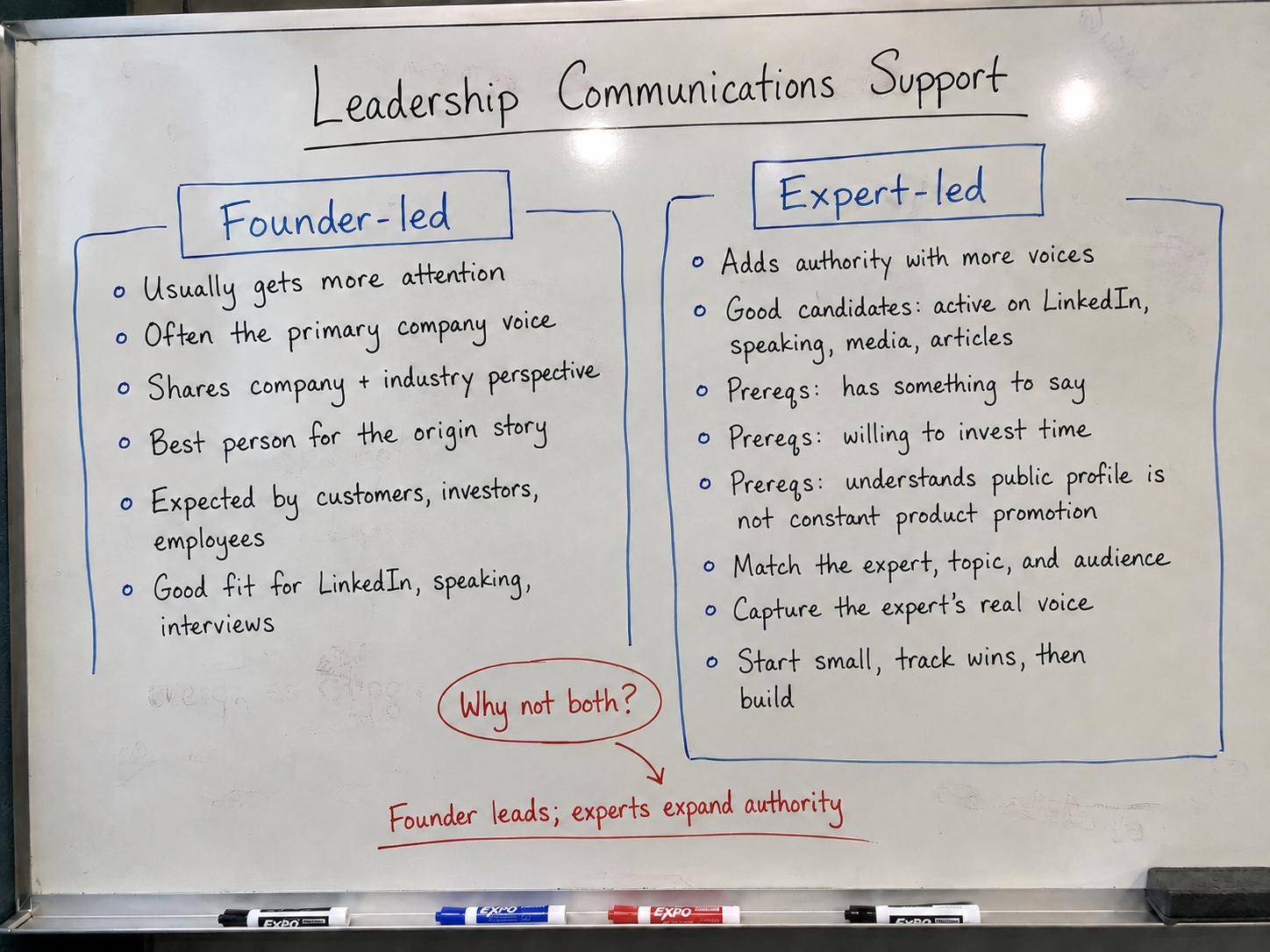
If the founder/CEO is regularly sharing insights, and a second leader or subject matter expert starts to do the same, does that give you double the impact?
Yes and no. Yes in terms of output, and perhaps engagement, assuming each one posts about the same and gets roughly the same results. But no in terms of equal weighting. In most cases, the founder’s voice captures more attention.
All of which leads to another question for marketing and communications leaders trying to bulk up the company’s thought leadership: Is it worth it to equip additional SMEs to post on LinkedIn, go for speaking engagements and interviews, and contribute their insights to the industry?
I would offer a resounding yes to that question.
Adding more voices
This often comes up as early-stage companies expand their marketing. If supporting the founder or CEO as the face of the company is working, it might be time to find a few additional voices to build even more authority.
Every startup marketing leader has the same reaction at this point: How do I support this when I don’t have enough hours to work on everything else in marketing, including lead-generation and revenue-building priorities?
That’s valid, of course. But it doesn’t really need to be a complicated process to identify and work with SMEs and other leaders, expanding gradually as results begin to come in.
One place to start is by seeing who’s already active on LinkedIn. Even if they’ve not created much content or commented on others’ posts, they’ve got a good foundation if they have more than 500 connections or followers and have at least occasionally engaged with others.
Beyond LinkedIn, anyone who has done any type of public speaking, been interviewed by a reporter or podcaster, or written peer-reviewed articles is a prime candidate for a public-facing role.
There are three obvious prerequisites:
- Internal SMEs and leaders need to have something to say and be comfortable sharing their thoughts.
- They should be willing to carve out some time to focus and work with the marketing team to develop ideas and content and to build relationships with external audiences.
- And they should have a baseline understanding of what it means to have a public profile – for example, knowing that they can’t constantly promote the product and company without offering something of broader value to the audience.
Here’s another consideration: Should SMEs – and not the founder or CEO – be the primary voice of the company? Most of the time, probably not.
Customers, prospects, employees, investors, and other stakeholders expect startup founders and CEOs to share their perspectives about the company and industry. The founder(s) can best tell the company’s origin story.
Meanwhile, other leaders and SMEs are expected to speak from their area of expertise. Of course, there’s often some overlap, and these are not hard-and-fast rules.
Making it work
So you’ve decided it’s time to add expert-led communications to build on your founder-led successes. What’s your approach?
These are a few guidelines I’ve used over the years in helping SMEs and leadership team members with their external communications:
Look for the right match between the expert, topic, and audience. Sometimes this is obvious, like having the chief medical officer speak or write from a clinical perspective. Other times the expert will need to stretch a bit. A clinician might need to discuss business strategy, for example. This is when prepping the executive or SME is critical. No telling how many times I’ve advised someone to speak or write from their base of knowledge and not be afraid to say they don’t have the answer.
Put some effort into capturing the expert’s voice and communications style. Review previous posts, articles, presentations, internal communications. Spend time with the expert. Talk to people who work with them. Where possible, join the expert on a few calls. And be ready to translate an SME’s deep and specific knowledge into a narrative that broader audiences can understand and appreciate.
Be strategic about media. Media interviews occupy a slightly different plane, typically with more involvement, because it’s harder to control the outcome. It’s best to identify a small number of people for the spokesperson role, then set aside time to provide media training. When working with an SME who’s serving as the public face of a product launch, be sure they can start with – and come back to – the big picture in media interviews.
Don’t take on too much at one time. Building an executive’s or SME’s public profile can be rewarding as more people in your target audiences start paying attention. Given the constraints inside most startups, there’s real risk in taking on too many internal experts, too many topics, and too much thought leadership content. Better to start small, nail the process, track wins and lessons learned, and build from there.